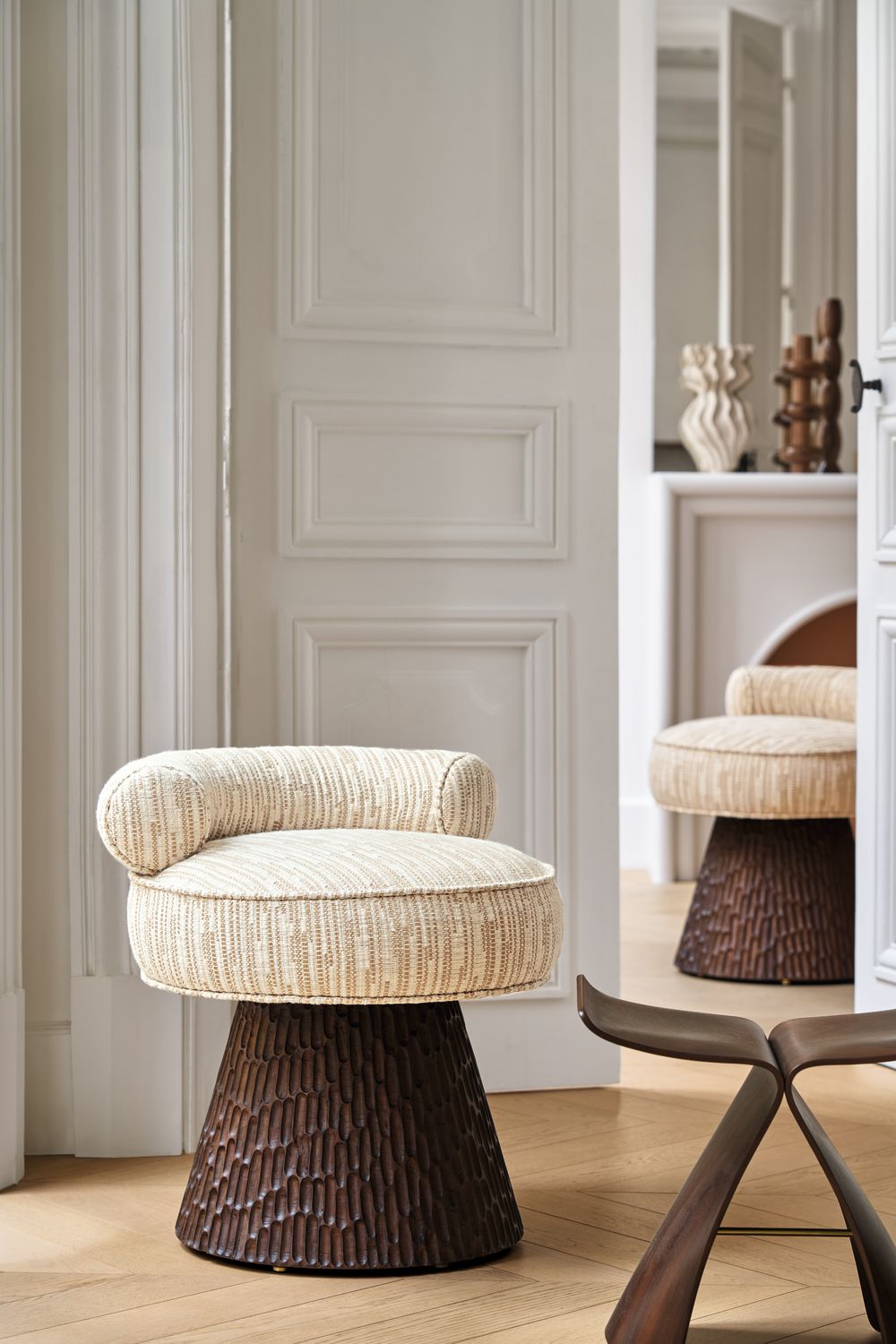
Casamance
Casamance | Flandres
Casamance | Flandres
Couldn't load pickup availability
Flandres is a woven fabric from Casamance for curtains and upholstery, made from 55% cotton, 30% viscose and 15% linen, with a useful width of 136 cm / 54 Inches.
It is used for curtains and upholstery.
Specification
| Minimum order | 1 metre (2 units) |
|---|---|
| Composition | 55% cotton; 30% viscose; 15% linen |
| Useful width | 136 cm / 54 Inches |
| Pattern match | Free match |
| Weight | 776 g/m² |
| Martindale | 30000 |
| Care | Do not wash; Do not bleach; Do not tumble dry; Do not iron; Mild professional dry cleaning |
| Country of origin | India |
| Usage | Curtains, Upholstery |
More details
Flandres is a dense woven cloth from Casamance, made mainly of cotton and linen with viscose added. The supplier describes the viscose as the part that lifts the cloth with a shine, and we read it the same way: the natural fibres lead the surface, with a little light running through it. It comes in two colourways, beige and écru, and in both the attention stays on the material and the weave rather than on any decoration. It belongs to the Côté Lin Les Naturels 6 collection, which says a good deal about the palette and the mood before you have seen the cloth itself.
The composition is 55% cotton, 30% viscose and 15% linen. The useful width is 136 cm, or 54 inches, and the pattern match is free, so there is no repeat to plan around. The supplier gives the weight as 776 g/m² and the Martindale figure as 30000, and the country of origin is India. The stated uses are curtains and upholstery. For care, the supplier advises that the cloth should not be washed, bleached, tumble dried or ironed, and that mild professional dry cleaning is the route to take.
We would use Flandres where a room is built from natural, quiet materials. For curtains, we would pair either colourway with plain walls in a close tone, so the cloth reads as part of the architecture and not as a feature. For upholstery, we would keep the surrounding palette restrained: oak or ash, plaster finishes, undyed linen cushions and a little black metal if the scheme needs an edge. Beige and écru sit close enough together that you could use one for curtains and the other for a chair in the same room without the two competing, and we would consider that if you want a gentle change of depth rather than a contrast. We would also look at it beside stone, rope and raw ceramics, where the viscose should show as a soft lift of light and not a gloss.
Before you order, ask us for a sample and look at it in the room where it will hang or sit, in daylight and in the evening, since the viscose will read differently as the light changes. Compare beige and écru side by side against your walls and floor, because the difference between them is small and only shows in context. Check the 136 cm width against the job, whether that is the drop of a curtain, the way panels will be joined, or the pieces needed for a chair or sofa. If you need any other detail on the cloth, please ask us.
- Selling unit: 0.5 metre
Share