de Le Cuona
de Le Cuona | Duchess Paisley – Classic
de Le Cuona | Duchess Paisley – Classic
Couldn't load pickup availability
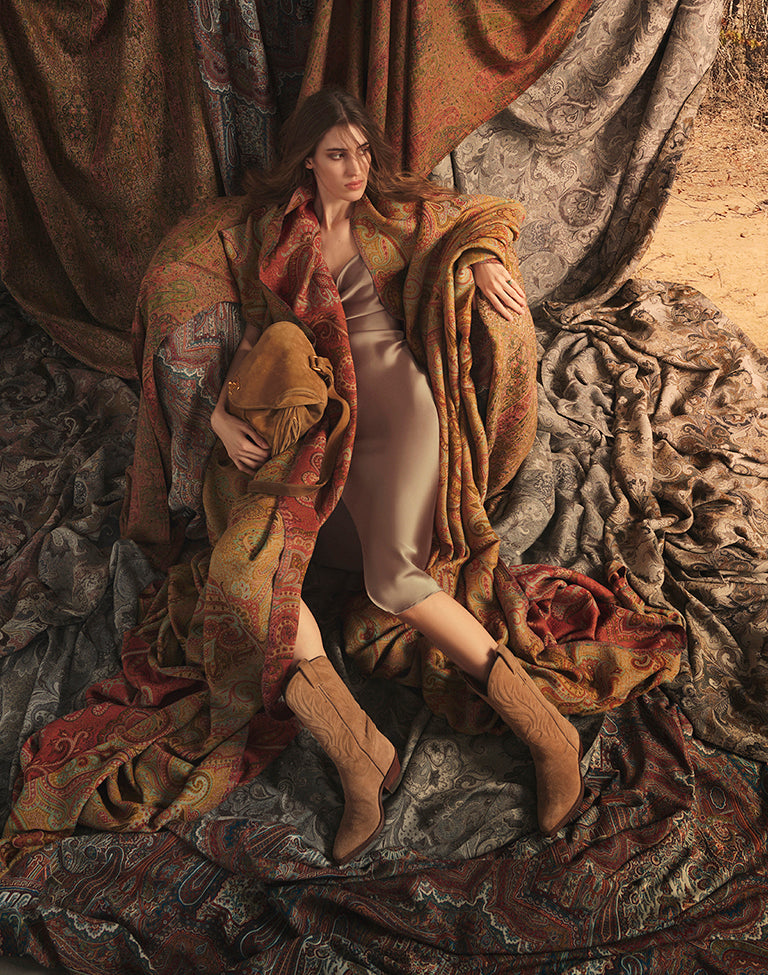
Duchess Paisley is a wool and cotton cloth with a paisley design that sits quietly in the weave rather than announcing itself. Paisley can run heavy and busy in the wrong hands, but this one is open and spaced, so the motif reads as a soft texture from across a room and only resolves into pattern as you come closer. We would expect a dry, substantial hand from a wool-rich blend like this, the kind of cloth that has body without feeling stiff. The scale is generous enough to suit a tall window.
The cloth is 75% wool and 25% cotton, and it is 150 cm wide. The vertical repeat is 57 cm and the horizontal repeat is 38 cm, which is a moderate drop and a fairly compact width of motif, so the pattern repeats often across a curtain rather than appearing as a single large gesture. It is sold by the half metre, which makes ordering a sample length straightforward. We do not have a Martindale figure for it, which is in keeping with its intended use as a curtain fabric rather than a hard-wearing upholstery cloth.
We would use Duchess Paisley for curtains first and foremost, particularly in a drawing room, a bedroom or a library where you want warmth at the window and some visual interest without colour. It will hang well on a pole or a track, and a wool blend gives a lovely fall when the curtains are made generously full. For pairing, we would keep the walls plain and mineral, and set it against a plain linen or a heavy herringbone on a nearby chair so the paisley has room to breathe.
With a 57 cm vertical repeat, the pattern has to be matched across each join, so allow extra fabric. As a rule of thumb, add at least one full repeat per drop, and ask your workroom to confirm the quantity before you order, as the numbers climb quickly on wide windows. Because the cloth is 150 cm wide, you will likely need more than one width per curtain, so ask for the pattern to be matched at the leading edge where it will be most visible. We would line and interline it to protect the wool from sunlight and to give the heading a clean, full shape.
Share