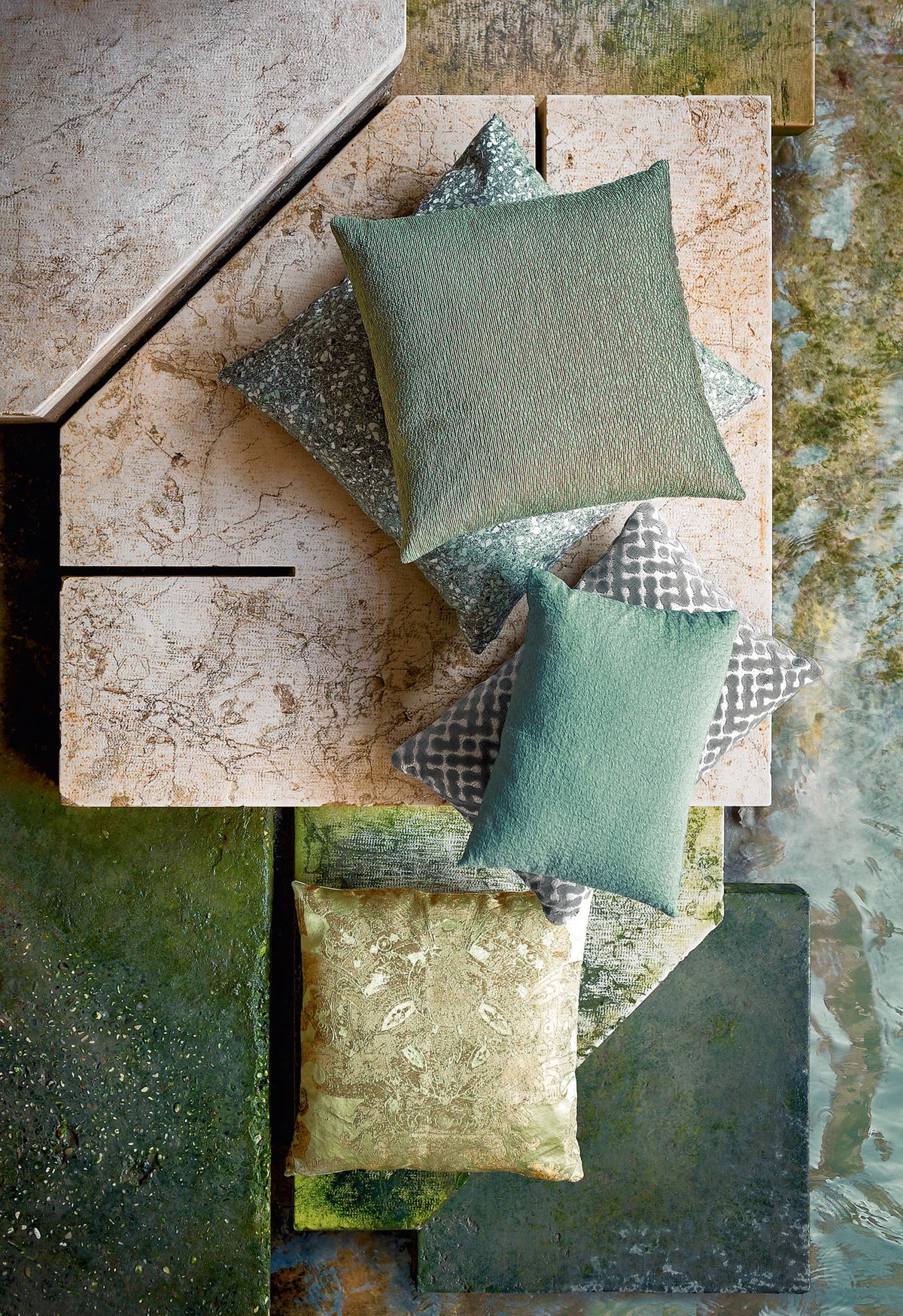
Almorò is what the trade calls a faux uni. Seen across a room it reads as a plain cloth, and only as you come closer do you notice the weft is irregular, which gives the surface a quiet texture without any pattern to match or centre. Rubelli describes it as a very strong upholstery fabric that is at the same time extremely soft in the hand, and puts that softness down to a flocked chenille weft. The listing covers twenty colourways, running from pale tones such as Avorio, Sabbia and Argento through the blues and greens of Acqua, Lago and Lichene to warmer shades like Zafferano, Mattone and Corallo.
The composition is 40% polyamide, 29% viscose, 29% cotton and 2% acrylic, and the cloth is 135 cm wide. It is a jacquard weave with a textured pattern, made in Italy, and the weight is given as 490 g per linear metre. The supplier states an abrasion result of 50,000 Martindale rubs. It carries the certification U.S.A. CAL.TB117:2013. The stated uses are upholstery and cushions, and we would keep to those. The style is contemporary.
Because the surface is textured rather than patterned, we would use Almorò where we want a sofa or armchair to feel calm and considered rather than plain. A faux uni of this kind is easy to live alongside. It sits well against a patterned curtain or a busy rug, and it gives the eye somewhere to rest in a room that already has plenty going on. We would also use it for cushions, where the hand of the cloth matters as much as the colour, and where two or three shades from the range can be combined in the same scheme. With twenty colourways, tone can be judged closely against walls, timber and existing furniture. We would be inclined to start from the lighter neutrals for a large piece and bring in the stronger colours on smaller ones.
A textured cloth changes with the light, so we would always want you to see a sample in the room it is meant for before committing, and to look at it by day and under lamps at night. Check the 135 cm width against the job, particularly for seat and back panels on larger upholstery, and ask your upholsterer how they intend to cut it. With an irregular weft we would also want any large piece to be cut from the same run, so it is worth talking that through at the outset. If you need any other detail, such as full care instructions, please ask us and we will find it for you.