Rubelli
Rubelli | Damasco Mirage
Rubelli | Damasco Mirage
Couldn't load pickup availability
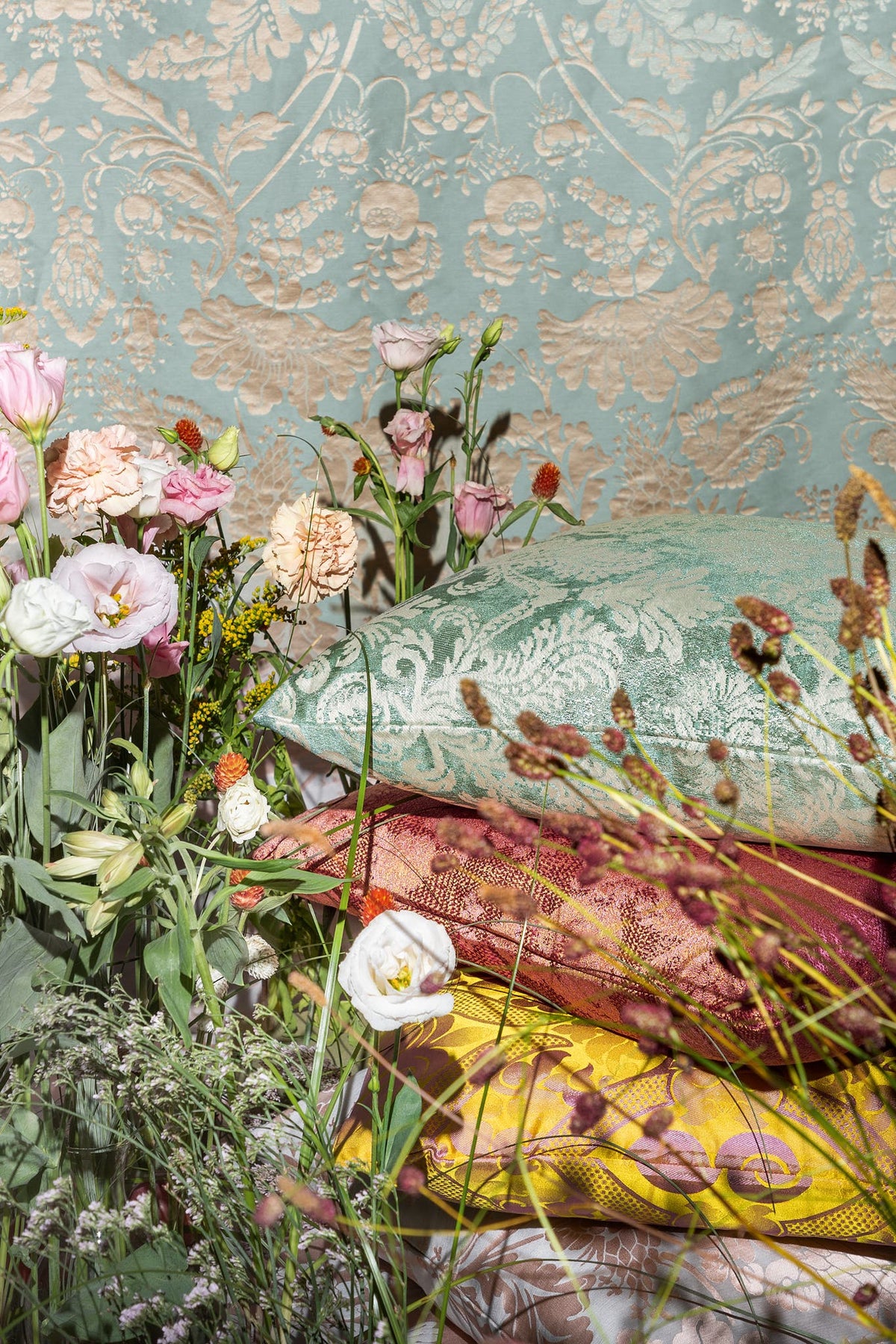
Damasco Mirage by Rubelli takes a classic damask and gives it a new reading. The pattern comes from an eighteenth-century archive document, and a latticework has been laid over it, which the supplier says gives the cloth a special luminosity. The older drawing sits beneath and the lattice holds the surface, so the design reads in two layers rather than as a single motif. The supplier describes it as the most elaborate of the new family of damasks in terms of the variety of weaves involved. The listing covers six colourways: Sabbia, Ciclamino, Arancio, Giallo, Bluette and Smeraldo.
The cloth is a jacquard weave in a damask pattern, made in Italy. The composition is 30% acetate, 29% viscose, 23% linen and 18% silk, and the weight is 330 g/lm. It is 140 cm wide, with a vertical repeat of 39 cm and a horizontal repeat of 35 cm. The stated uses are curtains, blinds and cushions. The supplier lists two certifications: U.S.A. CAL.TB117:2013 and UK Cigarette BS5852 source 0.
We would use this where the pattern can be read properly, so a pair of curtains in a drawing room or dining room is the first place we would look. A blind is a fair alternative, and we would think about where the window sits, since the layered design will look different depending on how the light falls on it through the day. Cushions are a good way to bring it in more quietly, on a plain sofa or a bed, where one considered piece of pattern is enough. We would keep the surroundings calm: a solid velvet, a plain linen or a painted wall in a close tone lets the damask lead. With six colourways to choose from, we would start from the colour already in the room and decide whether the cloth should sit close to it or contrast with it. Sabbia is the natural place to begin for a quiet scheme, while Bluette and Smeraldo will pull a room towards something deeper.
Before ordering, we would always look at a sample in the room where the cloth will hang, in daylight and again in the evening, because a design built on layered weaves changes with the light. Check the 140 cm width against your window or the piece you are making, and think about how the 39 cm vertical and 35 cm horizontal repeats will fall on the finished item, particularly if panels need to be joined. If you are making curtains, ask your workroom how much extra cloth they will want for pattern matching. We are glad to help with any detail you need, so do ask us.
Share