Rubelli
Rubelli | Damasco Pop
Rubelli | Damasco Pop
Couldn't load pickup availability
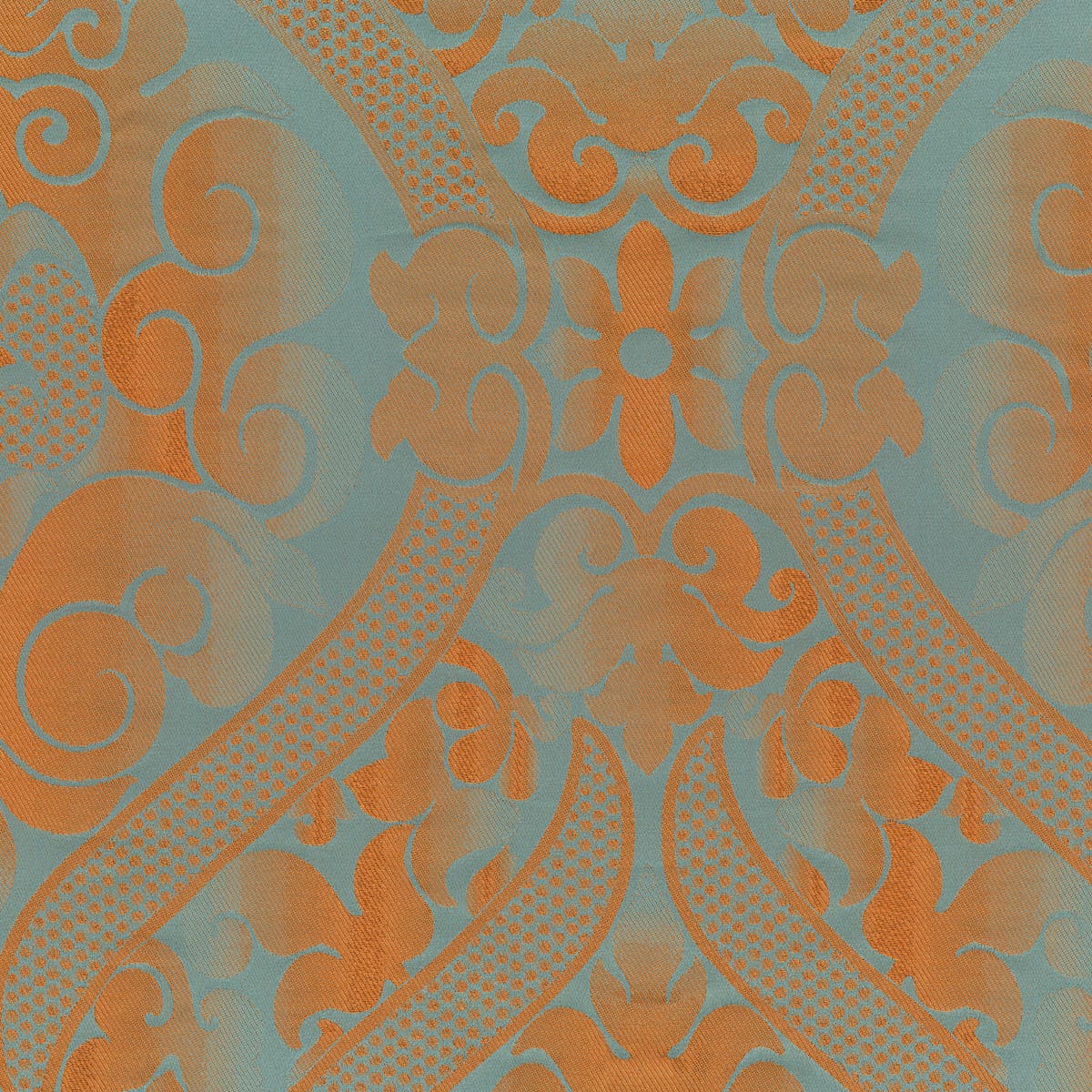
Damasco Pop by Rubelli takes the winding damask figure and sets it in pairs of very vivid colour. Each colourway is built from two shades, so the cloth reads one way from one angle and another from the next. The supplier describes it as a new meaning for damask, with delicate shaded weaves that soften the contrasts and an iridescent look that creates captivating combinations. The pattern itself is familiar; the colour is where the character lies.
The cloth is a jacquard weave in 40% acetate, 36% viscose and 24% silk, and it is 135 cm wide. The vertical repeat is 59 cm and the horizontal repeat is 34 cm. It weighs 240 g per linear metre and is made in Italy. The design is described as damask or paisley, and the listing covers five colourways: Giallo/rosa, Arancio/fuxia, Rosso/acqua, Rosa/grigio and Acqua/rame. The supplier lists certifications of U.S.A. CAL.TB117:2013 and UK Cigarette BS5852 source 0. The stated uses are curtains, blinds and cushions.
We would use Damasco Pop where colour is meant to lead. On curtains, the pattern has room to develop down the full drop, and we would keep the rest of the room quiet so the cloth can do the work. For a blind, we would think about where the figure falls on the finished piece before the cloth is cut. For cushions, we would take one of the two shades in a colourway and pick it up in a plain sofa or chair, then put the damask cushions against that. A solid velvet or a plain wool in one of the cloth's own colours sits well beside it. We would avoid adding a second pattern nearby and let this one carry the room. Where a colourway pairs two strong tones, such as Rosso/acqua or Arancio/fuxia, we would keep walls and large furniture calm and let the cloth be the one lively note.
Colour on a screen is only a guide, and a cloth that shifts between two shades is hard to judge from an image, so we would always look at a sample in the room before committing. Hold it up in the light you have, in the morning and in the evening, and see which of the two colours comes forward. Check the 135 cm width against the job, whether that is a window, a blind or a run of cushions, and allow for the 59 cm vertical repeat when you work out how much cloth you need. If you want any other detail on the cloth, or help choosing between the colourways, please ask us.
Share