Rubelli
Rubelli | Eliodoro Wall
Rubelli | Eliodoro Wall
Couldn't load pickup availability
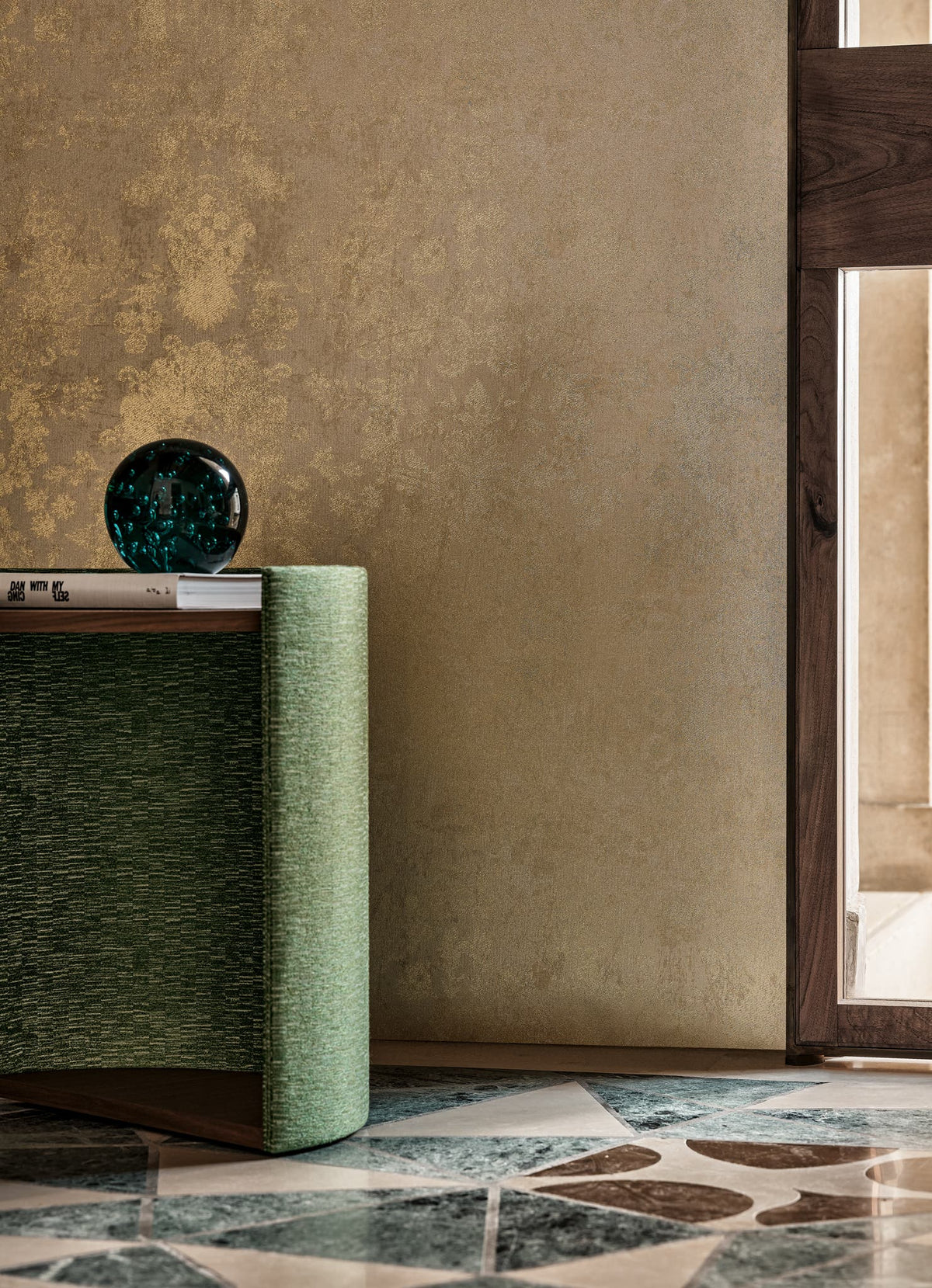
Eliodoro Wall is a wallcovering that takes a fabric design and translates it to the wall. Rubelli describes it as having the appearance of a precious metallic lace, and we think that is a fair reading: an open, fine-lined figure with a dull metallic quality rather than a bright one. The supplier says the pattern is large but not overbearing, a discreet decoration, and that the effect is of an old wall decoration with an oxidised, abraded surface. That worn character is deliberate. It is the look of a gilded wall that has been left alone for a few decades, and it gives a room a settled feel rather than a freshly decorated one. The design comes in five colourways: Avorio, Madreperla, Sabbia, Acqua and Peltro.
The composition is 100% fabric on a nonwoven ground, and the construction is non-woven. The width is 135 cm, with a vertical repeat of 85 cm and a horizontal repeat of 67.5 cm. The weight is given as 470 g/lm. The pattern is classed as a texture and the look as metallic. It is tested to EN 12149, methods A, B and C, and it is made in Italy by Rubelli, as part of the Rubelli Wallcovering collection. It is sold as a wallcovering and we would use it only as one, on walls.
We would use Eliodoro Wall where the walls are meant to carry the room, in a study, a dining room or a formal sitting room, rather than as a quiet backdrop to a busy scheme. Because the surface reads as texture and shadow before it reads as motif, it sits well behind a dark piece of furniture or a console, where the metallic quality catches the light without announcing itself. We would keep the rest of the room plain around it: unpatterned curtains, a simple velvet or linen on the seating, and woodwork in a flat, muted colour. Of the five colourways, we would look at the paler ones in rooms with good daylight and the darker, pewter-toned one where the lighting is lower and warmer, but we would judge that on a sample rather than from a screen. Metallic surfaces change a great deal with the direction and warmth of the light, so it is worth seeing how each one behaves at different times of day.
Before ordering, we would always look at a sample in the room where it will be hung, against your own light and your own furnishings. Check the width of 135 cm against the walls and openings in the job, and take the 85 cm vertical and 67.5 cm horizontal repeats into account when working out quantities, since pattern matching will use more material than the wall area alone suggests. We would also have the paper hung by a decorator who is used to working with designer wallcoverings. If you need anything else about this design, ask us and we will find it for you.
Share