Rubelli
Rubelli | Frank
Rubelli | Frank
Couldn't load pickup availability
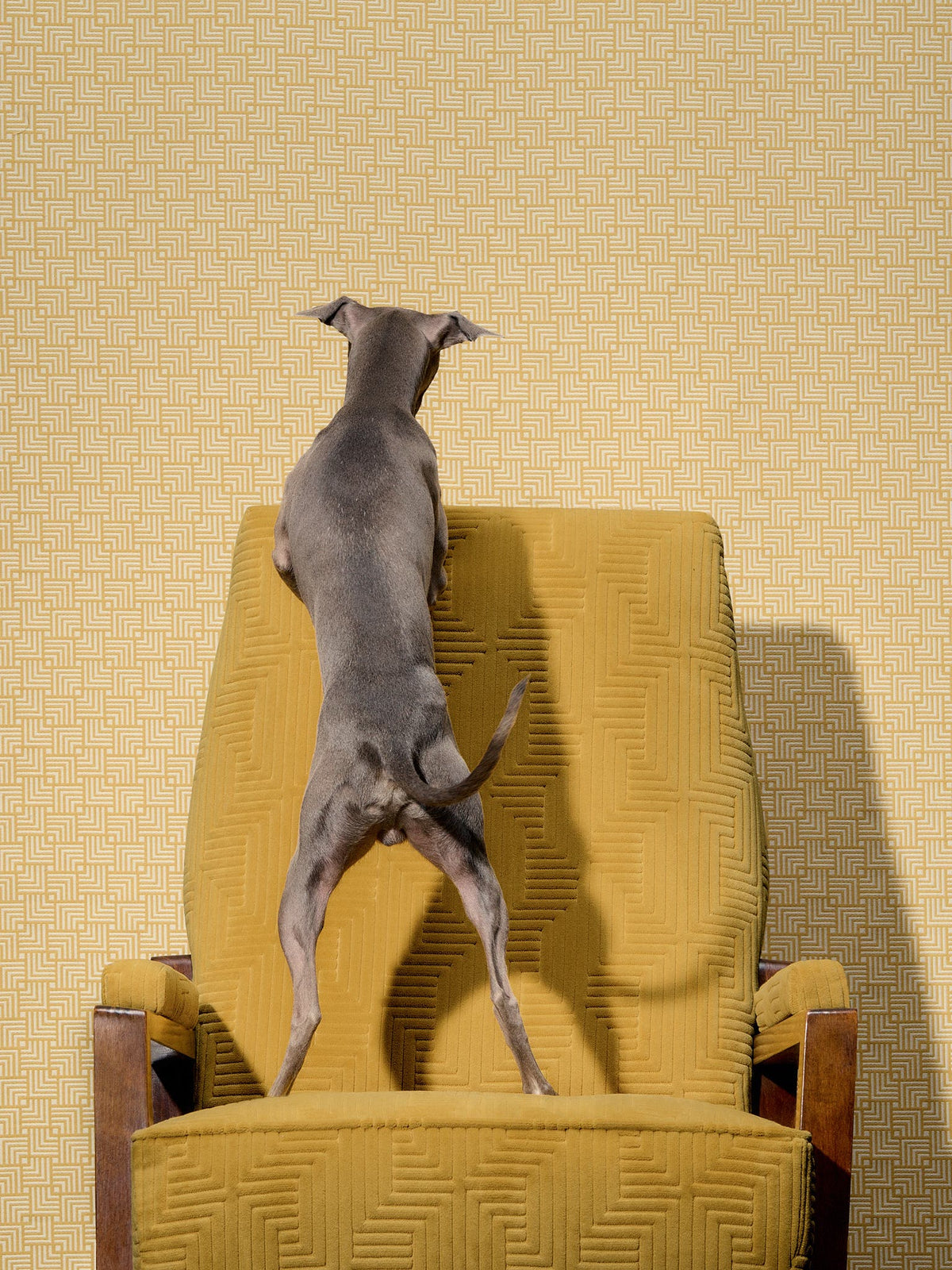
Frank is a jacquard velvet built around parallel lines, and the supplier ties the design to the work of Frank Stella and the American minimalist movement. Rubelli commissioned it from Formafantasma. A long cut pile is set against engraved lines, so the pattern comes from relief and shadow rather than from colour. The supplier describes it as a soft, opaque velvet with a strong three-dimensional surface, and calls it indestructible. We read it as a plain cloth with a quiet, architectural rhythm, and one that suits a contemporary room.
The composition is 100% polyester, and the pile is 100% flame-retardant polyester. The cloth is 140 cm wide, with a vertical repeat of 13.5 cm and a horizontal repeat of 17.5 cm. It weighs 890 g per linear metre and is woven in Türkiye. The Martindale result is 120,000 rubs. Certifications listed by the supplier are France M1 NFP92-503-504-505, Germany B1 DIN 4102-1, IMO 8 for upholstery, Italia Classe 1 for curtains, U.S.A. CAL.TB117:2013, UK Cigarette and Match BS5852 0-1, UK Contract curtains BS5867 and UK Contract upholstery BS7176. The stated uses are upholstery, cushions and curtains. There are 14 colourways, among them Avorio, Pietra, Argento, Salice, Oliva, Muschio, Lichene, Iris, Antracite, Ocra and Giallo, with Rosa antico, Ruggine and Rubino completing the range.
We would use Frank where the engraved lines can be seen across a good run of cloth: an armchair, a sofa or a length of banquette seating. Cushions in the same velvet would repeat the line elsewhere in the room, and we would keep the rest of the scheme plain so the relief does the work. In the paler colourways such as Avorio, Pietra and Argento the lines read softly, mostly as shadow. In the deeper ones, Antracite, Rubino or Ruggine for example, we would expect the surface to feel more dense, and we would look at them in the room before deciding. For curtains, the certifications make it a sensible option for rooms that need them. Because the design runs in lines, we would decide early whether they should run vertically or across the cloth, as that changes the cutting plan and the quantity needed.
Before committing, we would always ask to see a sample in the room where it will be used, at the time of day you use it most. Pile and engraving catch light differently from different angles, and a small piece will show you that better than a photograph. Check the 140 cm width against the job, particularly for wide upholstered panels or curtains, and think about the 17.5 cm horizontal repeat when planning how the lines fall across a seat or a cushion. If you need anything else, including full care instructions, please ask us and we will help.
Share