Rubelli
Rubelli | Grancanal Wall
Rubelli | Grancanal Wall
Couldn't load pickup availability
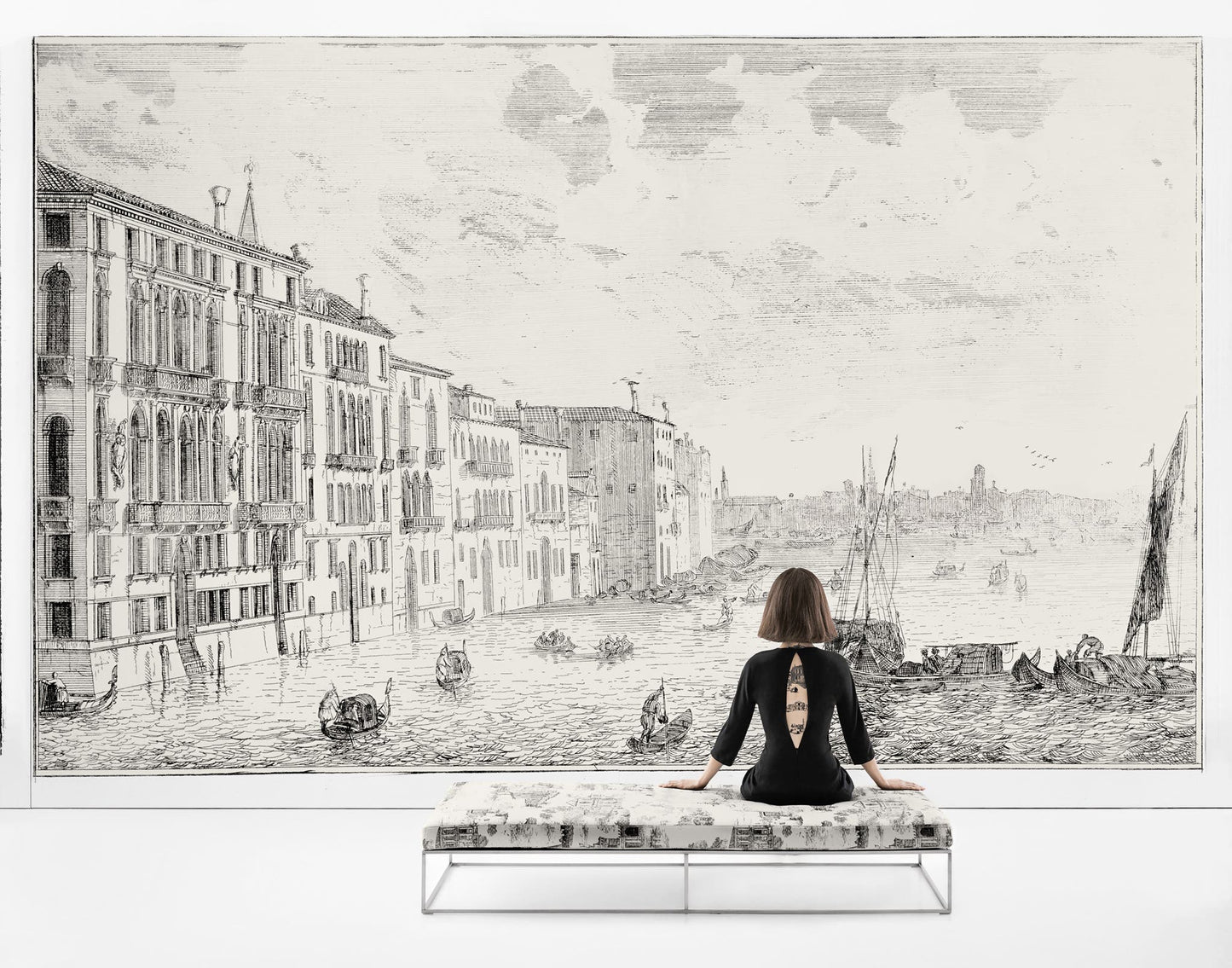
Grancanal Wall is a scenic mural from Rubelli, taken from an etching made in the early eighteenth century by Luca Carlevarijs, the painter usually described as the father of Venetian landscape painting. Rubelli chose to enlarge the image rather than repeat it, so the aim is that you feel you are stepping into the view instead of looking at a picture of it. This listing is for the Sepia colourway, a single monochrome tone that Rubelli's own description calls black and white. We would read it as the colour of an old print, quiet and tonal, with the drawing doing all the work.
The design is digitally printed on a nonwoven base and made in Italy. The width is 100 cm, and the scene is built from four 1 m panels for a finished height of 3 m. The horizontal repeat is 400 cm and the vertical repeat is 300 cm, which describes the full scene rather than a pattern that repeats up the wall. The pattern is scenic and the style is classic. It is a wallcovering, and we would use it only as one. The supplier gives certification to EN 13501-1 and ASTM E-84 for wallcoverings, and EN 12149 method A-B-C.
We would give this a single wall and keep everything around it calm. A dining room, a stair or the end of a long hall suits a scene of this kind, because there is room to stand back from it. Plain painted joinery, a soft plaster or lime-toned finish on the other walls, and simple, uncluttered furniture would let the print read as one image. We would light it from the side with low, warm wall or picture lights rather than flood it from the front, as a raking light gives an etched drawing more depth. If you want colour in the room, we would bring it in through textiles and rugs, and keep the mural as the one large idea.
Because the four panels make a single picture, we would plan the wall before ordering. Measure the height and the width of the wall you have in mind, and think about where the centre of the scene should fall, so that the joins are placed deliberately. The wall should be flat and sound, since a large print will show any unevenness underneath. We would always ask to see a sample in the room first, in the light it will actually receive, before committing to the full set. Check the 3 m height and the 4 m run against your wall, and ask us for any other detail you need before you order.
Share